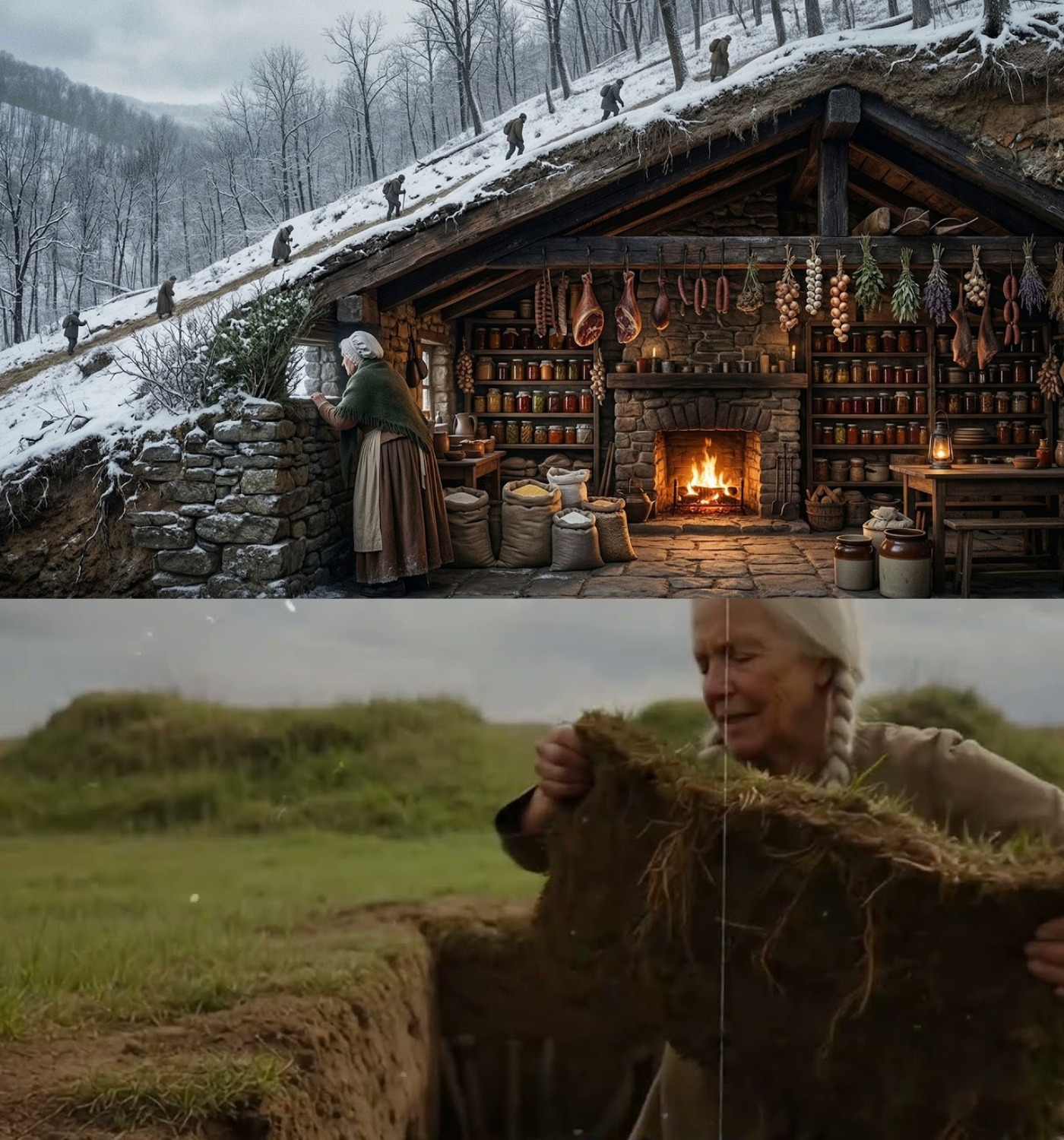
In the unforgiving winter of January 1863, Minnesota was gripped by a blizzard that would go down in history as an era-defining nightmare. Wind howled down from Canada at a blinding 70 miles per hour, whipping the snow into a whiteout fury that turned the world beyond the front door into a treacherous abyss. Homesteads vanished beneath 15-foot drifts. Livestock froze standing in the fields before they could even seek shelter.
Among the brave few who challenged the storm was Magistrate Alden Marsh. He led a desperate search party through the eastern townships, hunting for survivors. What they found was tragedy: the Hendrickson cabin’s roof collapsed under the snow, taking all four inhabitants with it. The Peterson homestead was buried so deep that only a smoking chimney gave away the location of the three half-frozen souls huddled inside.
But the strangest detail of that brutal week? As the search party scoured the frozen landscape, they walked directly over the roof of Sigrid Homberg’s home seventeen times—and never even knew it was there.
The Art of Disappearing
Deep beneath the snow and frozen prairie grass, Sigrid sat comfortably beside her crackling fire, listening to the heavy boots crunching above her ceiling. For seven long years, she had mastered the art of vanishing.
Her story of survival began in 1856 after the tragic loss of her husband, Eric, to a sudden fever. Left alone at just 26, Sigrid faced a hostile frontier that sought to strip her of everything she and Eric had built. Leading the charge was Magistrate Marsh, a man who wielded cold legalities like a weapon. He insisted a widow could not hold a homestead claim alone, presenting her with a ruthless ultimatum: remarry immediately, or sell the land to him.
With a heart shattered by grief but hardened by resolve, Sigrid looked the Magistrate in the eye and declared, “I’ll stay.”
Marsh scoffed, assuring her that no solitary woman could survive a Minnesota winter. He was nearly right. Sigrid knew her traditional wooden cabin left her too visible and too vulnerable. If she was to keep her land, she needed to disappear.
The Wisdom of Grandmother Deer
Salvation came in the form of Grandmother Deer, a 93-year-old Dakota elder who remembered the ancient ways of the land long before settlers arrived. Seeing the young widow’s desperation, the old woman taught Sigrid a profound lesson: do not fight the prairie; become part of it.
Under Grandmother Deer’s patient guidance, Sigrid learned the lost art of building an earth lodge. She spent the brutal months digging into the side of a deep hill, her hands blistering and bleeding as she carved out a subterranean sanctuary. She learned to weave a ceiling of thick timber and sod that would blend seamlessly with the rolling earth.
By the time spring thawed the ground, Sigrid’s hidden refuge was complete. The entrance was cleverly concealed within a natural fold of the hillside, and her chimney was perfectly disguised as a hollow, dead tree stump. From the surface, there was nothing to see but waving grass.
For years, Sigrid lived peacefully in her hidden lodge. She tended a secret sunken garden and raised a small flock of chickens, completely invisible to the world above. Every spring, Magistrate Marsh would ride out to the property, convinced she had perished and the land was finally his. He searched, but Sigrid remained unseen—a mere whisper in the prairie wind.
The Cry That Broke the Silence
Then came the Great Blizzard of 1863. As the storm raged above, dropping walls of white that obliterated the landscape, Sigrid felt the massive weight of the snow piling over her roof. Yet, deep in the earth, she remained perfectly safe, wrapped in a natural 55-degree warmth.
But the silence of her sanctuary was suddenly shattered. Through the howling wind above, she heard a sound that chilled her more than the ice ever could: a child, crying out in terror and desperation.
In that singular moment, Sigrid realized her safety had come at a heavy cost. She had isolated herself to survive, but she could no longer ignore the suffering of others. With a heavy heart, she pushed past her fears and forced her heavy, concealed door open, stepping out into the whiteout.
The search party—men, women, and children stumbling blindly toward their deaths—were suddenly pulled into the earth. They tumbled into a warm, fire-lit sanctuary that felt like a miracle. Among the shivering survivors stood Magistrate Marsh. As his eyes adjusted to the firelight, his jaw dropped in disbelief when he recognized the woman standing before him.
“You’re… you’re alive,” he stammered, shivering violently.
“I’ve always been alive,” Sigrid replied, her voice steady as stone. “You just couldn’t find me.”
A Legacy Built in the Earth
For nine days and nights, Sigrid sheltered the very people who had forgotten her, sharing her winter rations and the warmth of her hearth. As they huddled together in the earthen chambers, Sigrid’s heart, frozen since Eric’s death, finally began to thaw. She had chosen to be seen again, and in doing so, she had reclaimed her humanity.
“I survived seven years alone because I had no choice,” Sigrid told them softly. “But when I heard that child crying, I remembered what my husband used to say. We’re not meant to be alone. We’re meant to help each other.”
When the storm broke and the sun finally touched the snow, a changed group of people emerged from the earth. Magistrate Marsh stood before the survivors, the shame of his past greed etched deeply into his face.
“I tried to take her land,” Marsh confessed to the crowd, his voice cracking with regret. “I declared her dead because I wanted what she had. She could have stayed hidden. She could have let us die under the ice. But she opened her door.”
Homberg’s Hill
From that day forward, Sigrid Homberg was no longer a ghost; she was the heartbeat of the community. She lived for another forty years in her beloved earth lodge. She eventually married Jonas Lindgren, a kind man from the surviving search party, and together they raised four children, passing down the ancient wisdom Grandmother Deer had shared.
As for Magistrate Marsh, he resigned from his post, dedicating the rest of his life to helping new immigrant families build sturdy earth shelters. When he died in 1871, his gravestone bore a simple, haunting tribute: “She could have let him die. She didn’t.”
Today, the legend of “Homberg’s Hill” remains a staple of Minnesota folklore—a powerful reminder that true safety comes from embracing the earth rather than conquering it. And somewhere out on the prairie, beneath the waving grass, the hollow remains of an earth lodge still hold the memory of a woman who proved that the strongest walls are the ones we build to protect each other.
Disclaimer: Our website is designed for informational and entertainment purposes only. We are not a real estate company and do not engage in selling, listing, or brokering properties. We operate as a blog, curating and sharing interesting houses we find on various websites across the internet. All decisions related to real estate should be made in consultation with licensed professionals. We do not guarantee the accuracy or timeliness of the information provided. Use our content at your own discretion and risk.