The Shawl That Held Everything: A Powerful Lesson on Grief, Family, and True Value
When my mother passed away, the world didn’t feel the same anymore. Everything around me felt slightly distant, as if I were watching life through a thin layer of glass. Conversations sounded muted, movements seemed slower, and even the most familiar places lost their warmth and meaning. Grief has an incredible way of reshaping reality. In those early, fragile days, I was still trying to understand what had truly changed and how I was supposed to move forward. The formal reading of the will only added another heavy layer to that emotional burden.
The Day of the Will Reading
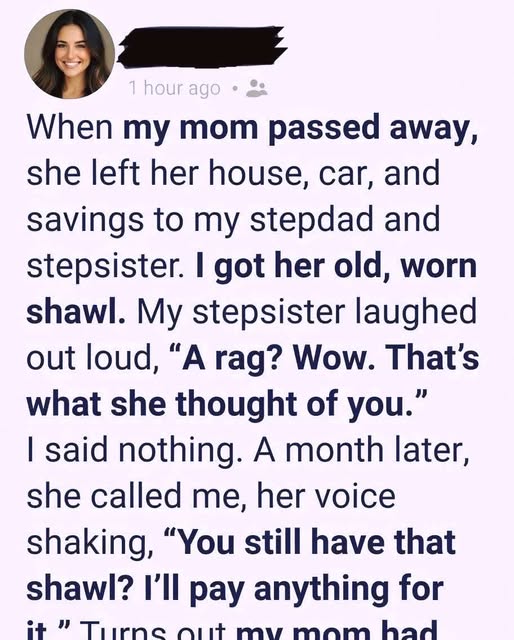
I sat quietly in a room filled with people who were technically family but felt emotionally far away. My stepfather and stepsister were awarded the house, the car, and the majority of the financial assets. I didn’t argue or question any of the decisions. I simply lacked the energy, and by that point, I already felt detached from the material outcomes.
When it was finally my turn, I was handed one small, modest item — my mother’s old shawl. It was soft, well-worn from years of use, and carried the faint scent of her favorite lavender soap. To the others in the room, it looked completely insignificant, almost like an afterthought in the distribution. My stepsister even let out a short, audible laugh, loud enough for everyone to hear, clearly highlighting how little the shawl was worth compared to everything else that had been given out. I remained silent. I carefully folded the shawl and placed it gently in my bag.
Why the Shawl Mattered More Than Money
What they failed to understand was that the shawl had never been about financial value. It was rich with memories, familiarity, comfort, and presence. I could still vividly picture my mother wearing it during quiet evenings at home, especially when she was tired after a long day or lost in reflection. She would wrap it gently around her shoulders while we talked about ordinary, everyday things — her garden, a book she was reading, or simple stories from her past. Those conversations seemed small at the time, but they became deeply meaningful after she was gone.
That old shawl wasn’t just a piece of clothing. It was one of the few tangible things I had left that still carried her warmth and essence. It represented love, quiet strength, and the peaceful moments we shared together.
When My Stepsister Suddenly Wanted It Back
Several weeks later, life had slowly settled into a new, quieter rhythm. It wasn’t normal, but it was stable enough to keep going. Then, unexpectedly, I received a phone call from my stepsister. Her tone was completely different from before — hesitant, uncertain, and almost uncomfortable. She asked if I still had the shawl and told me she wanted it back.
Her request wasn’t casual. It carried clear urgency. She didn’t fully explain why at first, but it was obvious that her perception of that simple item had changed dramatically. The very thing she had once dismissed and even mocked had suddenly become important to her. That surprising shift stayed with me long after the call ended.
Unexpected Support During Life’s Hardest Moments
Around the same time, several other experiences in my life taught me how fragile yet beautiful human connections can be.
My relationship with my father had been strained for many years, especially after he refused to attend my wedding. That decision created a painful distance that neither of us tried to repair. We stopped speaking, and silence slowly replaced what used to be communication.
Years later, I suffered a sudden and serious medical emergency at work. In that moment of panic and confusion, I instinctively listed my father as my emergency contact. To my surprise, he arrived quickly, authorized treatment without hesitation, and stayed by my side throughout the recovery process. He coordinated with doctors and handled details I couldn’t manage. We didn’t revisit the past immediately. He never explained his absence at the wedding. Instead, he simply said that losing me would have been far worse than any disagreement we ever had. It was one of the most emotionally open statements he had made in years.
My younger brother showed similar quiet strength when I developed a severe panic disorder. I began withdrawing from daily life and struggled to leave the house. Instead of pulling away, he stepped closer. He drove me to therapy appointments week after week, remained consistent even when progress was slow, and learned grounding techniques alongside me so he could help me practice them in real situations. He never treated me as fragile — he simply stood beside me.
Small Acts of Kindness from Unexpected People
At work, I faced another difficult challenge when I was wrongly blamed for a major error made by my supervisor. I lost my position, and unofficially, future opportunities in my field. The truth was never made public, making it extremely hard to rebuild my career. I even considered leaving the profession entirely.
Then a former colleague I barely knew reached out privately. She had seen internal communications that proved I was not responsible. Despite putting her own job at risk, she shared the evidence and helped me challenge the decision. Her actions were driven purely by a sense of fairness.
In another situation, I witnessed a pregnant woman in a hospital waiting room nearly being turned away because she lacked proper identification. As tension rose, another woman calmly intervened and said the pregnant woman was with her. That single, small act immediately eased the situation and allowed her to receive care without further delay.
What the Shawl Ultimately Taught Me
Over time, I began to see a clear pattern in all these experiences. In moments of vulnerability, grief, and uncertainty, support rarely came from formal systems or the people I expected. Instead, it came from unexpected individuals — friends, colleagues, family members, and even strangers — who chose to act with quiet kindness and integrity.
The situation with the shawl eventually resolved without any dramatic revelation or hidden inheritance. Its true value was never financial or legal — it was deeply emotional and personal. My stepsister’s sudden interest appeared to stem more from a changed perspective once she realized how much it meant to me.
Grief and crisis have a way of revealing true character. They strip away pretense and show us who people really are. Some step forward quietly to help, expecting nothing in return. Others only notice value once they see it matters to someone else.
Today, the shawl remains with me. Not as a valuable possession or symbol of wealth, but as a beautiful reminder of memory, connection, and the complex ways we assign meaning to both objects and relationships.
Final Lesson: What appears completely insignificant to one person can hold an entire world of history, love, and meaning for another.
Disclaimer: Our website is designed for informational and entertainment purposes only. We are not a real estate company and do not engage in selling, listing, or brokering properties. We operate as a blog, curating and sharing interesting houses we find on various websites across the internet. All decisions related to real estate should be made in consultation with licensed professionals. We do not guarantee the accuracy or timeliness of the information provided. Use our content at your own discretion and risk.