?
Think you’re good with numbers and logic? This classic riddle has fooled millions of people online. It sounds simple at first, but most readers confidently give the wrong answer. Are you ready to test your brain?
Here’s the scenario:
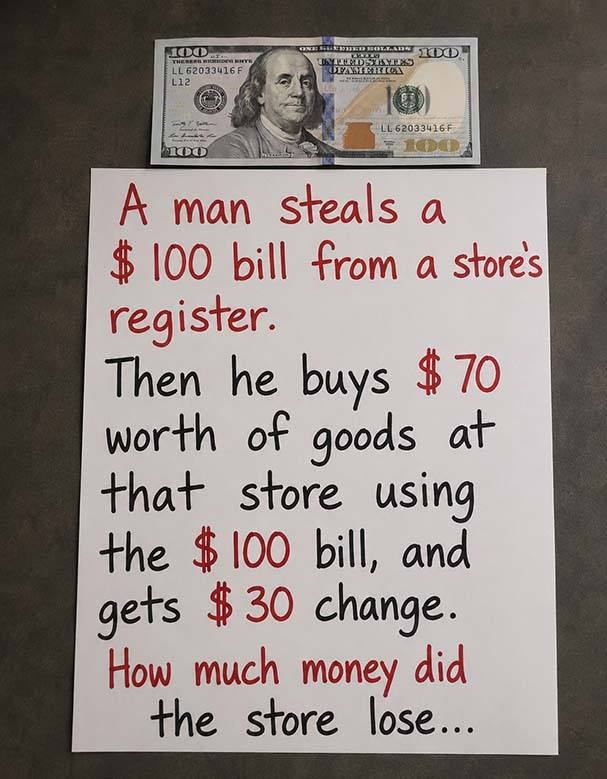
A man walks into a store and steals $100 from the cash register. Later, he comes back and uses that same stolen $100 bill to buy $70 worth of merchandise. The cashier gives him $30 in change. The question is: How much money did the store actually lose?
The Most Common Wrong Answers
Many people immediately say $200.
They think: “The store lost $100 from the theft, plus another $100 because the thief got $70 in goods + $30 in change.”
Others say $170.
They think: “The store lost the original $100 plus the $70 in merchandise.”
Both answers feel logical at first glance. But they are incorrect.
Let’s Break It Down Slowly
To solve this correctly, you have to track exactly where the money goes — step by step — without double-counting.
Step 1: The Theft
The man steals $100 cash from the register.
At this moment, the store has lost $100. That part is clear.
Step 2: The Purchase
The thief returns and uses the exact same stolen $100 bill to buy $70 worth of products.
The cashier accepts the bill (not knowing it was stolen) and puts it back into the register.
The store now has its $100 back.
Then the cashier gives the thief:
• $70 worth of merchandise
• $30 in change
The Key Detail Most People Miss
The original stolen $100 bill has now returned to the cash register.
That means the store is no longer missing that $100.
What the store is permanently missing is:
• The $70 worth of products given away
• The $30 cash given as change
70 + 30 = 100
Why Our Brains Get Tricked
This riddle is tricky because our minds want to treat the theft and the purchase as two completely separate events.
We see “stolen money” and “merchandise + change” and automatically add them together.
But they are connected by the same $100 bill. Once that bill returns to the register, it can’t be counted as a loss anymore.
The store does NOT lose $200.
The store does NOT lose $170.
The store loses exactly $100.
The Final Reveal: The store lost exactly $100. The thief stole $100, then used that same bill to buy $70 worth of goods and received $30 in change. The original stolen money returned to the register, leaving the store short only the merchandise and the change — which together equal $100.
Why This Riddle Is So Popular
People argue about this one for hours online. Some refuse to accept the answer even after seeing the explanation. That’s because our brains naturally separate the two events and count the same money twice.
It’s not really a math problem — it’s a thinking problem. It shows how easily we can be misled when we don’t carefully track what actually happens to the money.
Try It on Your Friends
Next time you’re with family or friends, share this riddle and watch their reactions. Most people get it wrong the first time. When they finally see the correct answer, the “aha!” moment is always fun.
These kinds of brain teasers are great because they train you to slow down, look closer, and avoid jumping to quick conclusions. The math is simple once you follow the money step by step.
So… did you get it right on your first try? Or did the riddle trick you too?
This is a popular riddle originally shared and discussed across various internet communities and forums.
Disclaimer: Our website is designed for informational and entertainment purposes only. We are not a real estate company and do not engage in selling, listing, or brokering properties. We operate as a blog, curating and sharing interesting houses we find on various websites across the internet. All decisions related to real estate should be made in consultation with licensed professionals. We do not guarantee the accuracy or timeliness of the information provided. Use our content at your own discretion and risk.