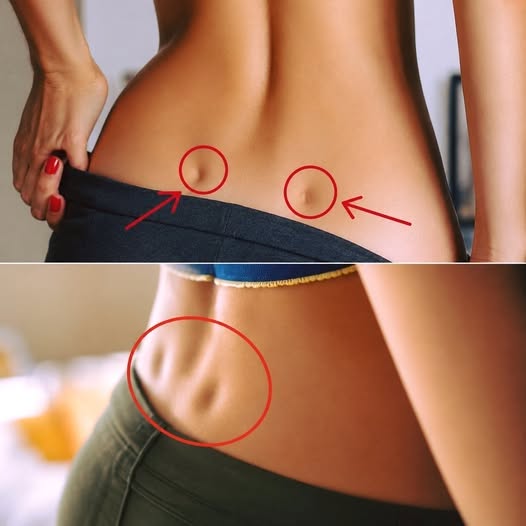
Have you ever noticed two small, symmetrical indentations on the lower back, just above the buttocks? Many people have them, and they often catch attention because of their unique and natural look. These little dimples have been admired for generations and are commonly known as Venus dimples, named after the Roman goddess of beauty.
While they may seem like a special feature, what do they actually tell us about the body? Are they a sign of good health, strong muscles, or something else entirely? Let’s take a closer look at what science and anatomy say about these intriguing little marks.
What Are Venus Dimples, Exactly?
Venus dimples are small, natural indentations that form where a short ligament connects the skin directly to the pelvic bone (specifically the posterior superior iliac spine). This connection creates a gentle inward pull, resulting in the visible dimple on each side of the lower back.
Because they are formed by bone structure and connective tissue, they are not something you can create through exercise, weight loss, or any kind of training. A person either naturally has them or does not, based on their individual skeletal anatomy and genetics.
In men, similar indentations are sometimes called Apollo dimples, but medically they are considered normal variations of the human body with no special health advantage or disadvantage.
They Are Determined by Genetics, Not Lifestyle
Venus dimples are primarily an inherited trait. If your parents or close relatives have them, there’s a good chance you might too. They are not influenced by how much you exercise, how much body fat you carry, or how active your lifestyle is.
That said, they tend to be more visible in people with lower body fat because there is less soft tissue covering the natural indentation. However, their presence or absence is not a reliable measure of fitness, strength, or overall health.
Common Myths vs. Medical Facts
Over the years, various claims have circulated about what Venus dimples might indicate. Some people believe they are a sign of good circulation, strong back muscles, better posture, or even reduced risk of back problems. Unfortunately, there is no strong scientific evidence to support these ideas.
From a medical perspective, Venus dimples are considered harmless anatomical features. They are not linked to any specific health condition, nor do they serve as a diagnostic sign for internal health, blood flow, or physical performance. They are simply one of many normal variations in human skeletal structure — similar to differences in wrist shape, ear structure, or facial symmetry.
Why They Stay the Same Throughout Life
Unlike wrinkles, skin tone changes, or muscle definition, Venus dimples do not appear or disappear over time. Because they are tied directly to bone and ligament structure, they remain consistent throughout a person’s life if they are genetically present.
This stability is one reason they often draw attention — they stay the same even as other parts of the body naturally change with age.
The Cultural and Aesthetic Side
Despite having no medical significance, Venus dimples have long been associated with beauty in art, sculpture, and popular culture. Their symmetrical placement and gentle curves have been admired as symbols of physical harmony and attractiveness.
This cultural appreciation is understandable, but it’s important to remember that beauty comes in many forms. Whether someone has prominent dimples, faint ones, or none at all, all variations are completely normal and equally valid.
What Actually Matters for Your Health
While Venus dimples are interesting to look at, they do not define health, fitness, or physical capability. What truly supports long-term well-being is consistent care for the body as a whole.
Regular movement, good posture, proper nutrition, and maintaining core strength are far more important for spinal health, mobility, and overall vitality than any external anatomical feature. As we age, focusing on these practical habits helps prevent stiffness and supports independence far more than any visible dimple ever could.
The Final Reveal: Those small dimples on your lower back, commonly called Venus dimples, are a completely normal anatomical feature caused by a short ligament connecting the skin to the pelvic bone. They are determined by genetics and skeletal structure — not by exercise, body fat percentage, or lifestyle. While they are often admired for their appearance, they do not indicate better health, stronger muscles, improved circulation, or any medical advantage. They are simply one of many natural variations that make every human body unique. Whether you have them or not, they are harmless and do not reflect your overall fitness or well-being.
Embracing Natural Body Diversity
Human bodies come in all shapes and forms, and small features like Venus dimples are just one example of that beautiful diversity. Some people have very noticeable dimples, while others have faint or no visible indentation at all — and both are perfectly normal.
Instead of focusing on specific physical traits, the most valuable thing we can do is appreciate our bodies for what they allow us to do every day. Strength, mobility, energy, and comfort matter far more than any single external detail.
Venus dimples are a gentle reminder that our bodies are wonderfully complex and unique. Whether present or absent, they are simply part of the natural design that makes each of us who we are.
This is a popular anatomy and body positivity topic originally shared and discussed across various internet communities and forums.
Disclaimer: Our website is designed for informational and entertainment purposes only. We are not a real estate company and do not engage in selling, listing, or brokering properties. We operate as a blog, curating and sharing interesting houses we find on various websites across the internet. All decisions related to real estate should be made in consultation with licensed professionals. We do not guarantee the accuracy or timeliness of the information provided. Use our content at your own discretion and risk.