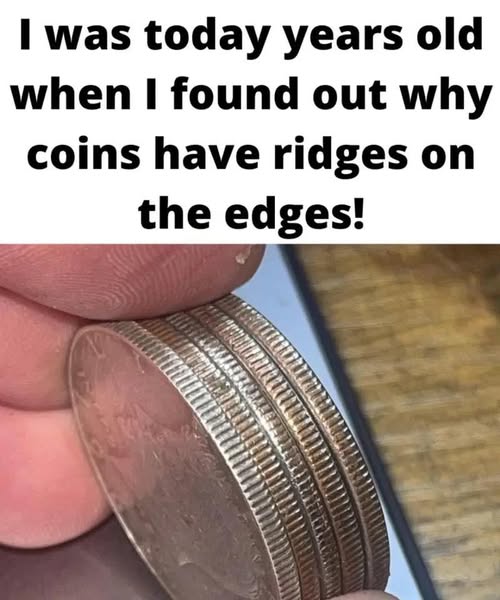
You’ve held them thousands of times. Quarters, dimes, and other coins pass through your hands every week. You probably never stop to wonder about the small grooves running along their edges. They feel normal. Familiar. Almost invisible. But those tiny ridges are not just decoration. They exist for a very specific reason — one that goes back hundreds of years and involves crime, lost fortunes, and a surprising historical figure.
The Problem That Once Threatened Entire Economies
Hundreds of years ago, coins were made of real silver and gold. Their value came not just from what they could buy, but from the precious metal inside them. This made them tempting targets. Criminals discovered a clever and quiet way to steal: they shaved off tiny amounts of metal from the edges of coins. This practice was called “coin clipping.”
A clipped coin still looked mostly normal, so it could be spent at full value. The thief would collect the shavings, melt them down, and sell the pure metal. One coin didn’t seem like much. But when thousands of coins were clipped, the losses became massive. Merchants stopped trusting currency. Governments lost valuable metal reserves. The entire money system began to weaken.
How People Tried to Fight Back
At first, authorities tried harsh punishments — including the death penalty — to stop the clipping. But the crime continued. The edges of coins were too easy to tamper with. Something had to change. A better solution was needed to protect the money that everyone used every day.
That solution came in the form of tiny grooves added around the edge of coins. These grooves, known as “reeded edges,” made any tampering instantly visible. If someone tried to shave the coin, the neat pattern of ridges would be broken or uneven. A genuine coin showed a perfect, continuous pattern that was very difficult to fake accurately.
Why the Ridges Still Exist Today
Modern coins are no longer made from valuable silver or gold. So why do the ridges remain? There are several practical reasons that still matter in our world.
Vending machines and coin-sorting systems use the ridges to check if a coin is real. The grooves also help visually impaired people tell coins apart by touch — a smooth nickel feels very different from a ridged dime or quarter. Tradition plays a role too. The ridges have become part of how we expect coins to look and feel, connecting today’s money to centuries of history.
Pennies and nickels usually stay smooth because they were never valuable enough for clipping to be worth the risk. But dimes and quarters kept their ridges as a lasting reminder of the past.
The Everyday Detail We All Overlook
Next time you hold a coin, run your finger along the edge. Those small grooves tell a story of trust, crime, and human ingenuity. They represent a time when money itself was under attack and society had to get creative to protect it.
What started as an anti-theft measure has quietly survived into the digital age. Even though we use cards and phones more often now, coins still carry this small but important feature from our monetary past.
A Battle That Changed Currency Forever
The ridges on coins are surviving evidence of an old war over trust and value. They remind us that even something as simple as money has a hidden history full of clever solutions to serious problems. What seems like a small design choice actually helped save entire economies from collapse.
These tiny grooves continue to serve us today in ways most people never notice. They help machines, help people with vision differences, and preserve a tradition that stretches back hundreds of years.
The Final Reveal: The reeded edges we still see on coins today were introduced in the late 1600s by none other than Isaac Newton while he served as Warden of the Royal Mint. His solution to the widespread problem of coin clipping helped restore confidence in money and protected economies for generations.
This is a fascinating historical story originally shared and discussed across various internet communities and forums.
Disclaimer: Our website is designed for informational and entertainment purposes only. We are not a real estate company and do not engage in selling, listing, or brokering properties. We operate as a blog, curating and sharing interesting houses we find on various websites across the internet. All decisions related to real estate should be made in consultation with licensed professionals. We do not guarantee the accuracy or timeliness of the information provided. Use our content at your own discretion and risk.